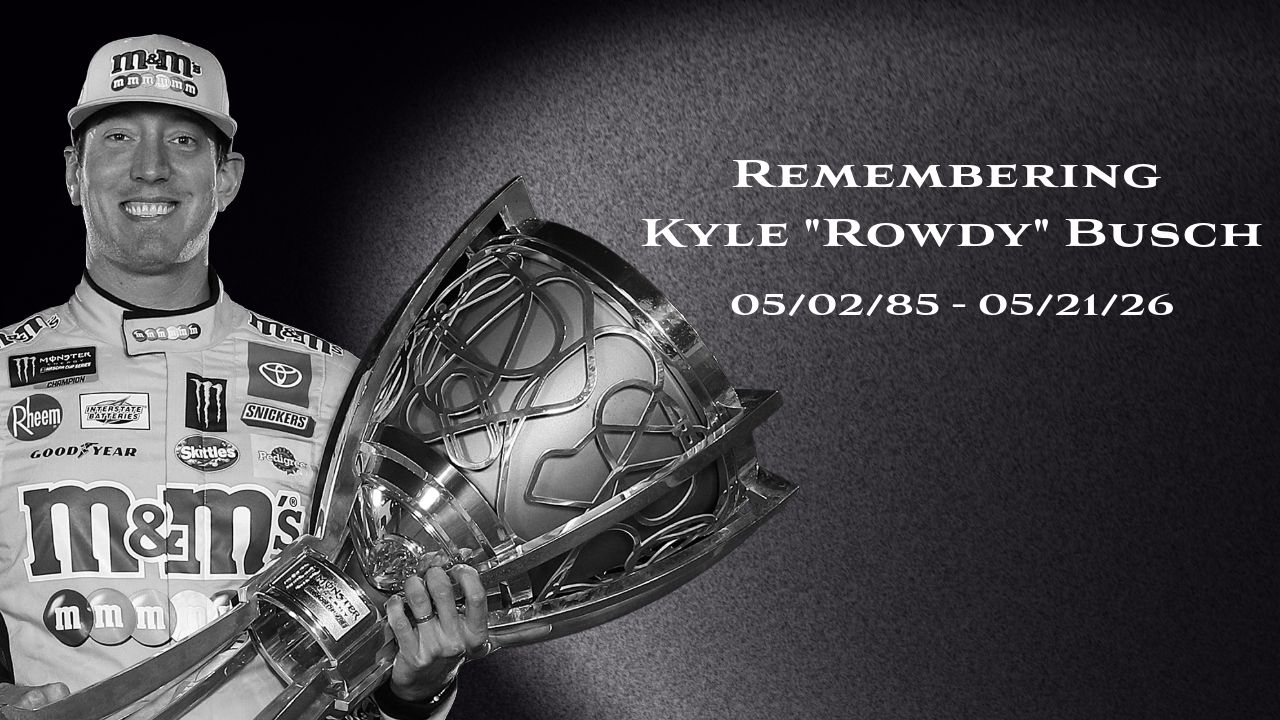
Kyle Busch tragically passed away on May 21st, 2026, as initially reported by NASCAR
Few drivers in modern NASCAR history were as talented, controversial, dominant, and unforgettable as Kyle Busch. To some fans, he was the arrogant villain who always had something to say. To others, he was the fiercest pure racer of his generation, a driver willing to race anything with four wheels at any track, any night of the week. Love him or hate him, NASCAR was never boring when Kyle Busch was around.
From his early days as a teenage prodigy to becoming the face of Toyota’s rise in NASCAR, Busch built one of the most important careers the sport has ever seen. His story was one of raw talent, public controversy, redemption, and longevity. In many ways, he carried NASCAR through one of its most difficult modern eras while becoming one of the defining stars of the 2000s and 2010s.
The Start of “Rowdy”
Born in Las Vegas, Nevada, Kyle Busch was introduced to racing at an incredibly young age. Following in the footsteps of his older brother Kurt Busch, Kyle began racing go karts before moving into Legends cars and late models as a teenager. His talent became obvious almost immediately. Busch drove with aggression, confidence, and a level of car control that stood out even among NASCAR’s rising stars.
Because he was too young to legally compete in certain NASCAR events at first, Busch developed a reputation before he even reached the Cup Series. He was fearless and occasionally reckless, but undeniably fast. That aggressive style earned him the nickname “Rowdy,” a nod to the character Rowdy Burns from the movie Days of Thunder.
Rookie Sensation at Hendrick Motorsports
Busch made his NASCAR Cup Series debut in 2004, driving for Hendrick Motorsports, replacing the retiring Terry Labonte in the iconic No. 5 Chevrolet. At only 19 years old, Busch instantly showed flashes of brilliance.
In 2005, during his first full Cup season, he won twice and captured NASCAR Rookie of the Year honors. His breakout moment came at California Speedway, where he became, at the time, the youngest winner in Cup Series history. NASCAR had found its next superstar, even if fans were not sure yet whether they wanted to cheer for him or boo him.
Busch’s talent at Hendrick was unquestionable, but his personality quickly made him one of the sport’s most polarizing figures. He clashed with drivers, argued with media members, and openly showed frustration when things went wrong. At a time when NASCAR still had many corporate, polished personalities, Busch felt raw and emotional.
Even during those early years, many veterans viewed Busch as talented but immature. His aggressive driving style and emotional outbursts created tension throughout the garage, but they also made him impossible to ignore.
Becoming the Face of the No. 18
In 2008, Busch made the move that would define his career, joining Joe Gibbs Racing to drive the famous No. 18 Toyota. The switch shocked many fans. Toyota was still relatively new in NASCAR and remained unpopular among traditional audiences. Busch quickly became the perfect centerpiece for the manufacturer’s rise.
At Joe Gibbs Racing, Busch evolved from talented young driver into one of the most dominant racers NASCAR had ever seen. He won everywhere. Short tracks, intermediates, superspeedways, road courses, dirt races, trucks, Xfinity cars. If there was a steering wheel involved, Kyle Busch believed he could win in it.
His statistics became staggering. He eventually broke records for wins in the Xfinity Series and Truck Series while adding more than 60 Cup Series victories and two Cup championships in 2015 and 2019.
The 2015 title especially defined his toughness. Busch suffered devastating leg injuries during the season opener at Daytona after crashing into an exposed wall. Many thought his season was over. Instead, he returned months later, won multiple races, and captured the championship in one of the most remarkable comeback stories in NASCAR history.
Carrying NASCAR on his back
NASCAR’s popularity declined significantly from its peak in the mid 2000s into the late 2010s. Ratings fell, legendary stars retired, and the sport searched for its next generation of household names after the departures of drivers like Jeff Gordon, Tony Stewart, and Dale Earnhardt Jr..
During that period, Kyle Busch became one of the few drivers who could still consistently generate headlines, emotions, and mainstream attention. Fans either loved him or despised him, but they always reacted to him. NASCAR desperately needed personalities during an era where many drivers became increasingly media trained and cautious.
Busch embraced the role of villain in a way that felt authentic. He did not hide his anger after bad finishes. He openly criticized competitors and NASCAR itself. He celebrated aggressively when he won. That emotional honesty kept him relevant and made him one of the last true “must watch” personalities in stock car racing.
In many ways, Busch carried the old spirit of NASCAR into the modern era. He represented the rough edges and emotional intensity that many longtime fans missed.
Rivalries, Controversy, and Iconic Interviews
Kyle Busch’s career cannot be discussed without mentioning the rivalries. He feuded with nearly every major driver of his era at one point or another. His clashes with Kevin Harvick, Brad Keselowski, Joey Logano, and others became legendary moments in modern NASCAR history.
Yet underneath the controversy, there was often respect. Busch raced aggressively because he expected greatness from himself and others. Many drivers who fought with him eventually admitted they respected his talent and intensity.
That competitive fire also produced some of NASCAR’s most iconic interviews and quotes. Whether he was angrily declaring “Everything is great!” after a frustrating race or delivering sarcastic one liners during interviews, Busch became endlessly quotable. His interviews often spread across social media because fans knew anything could happen when a microphone was placed in front of him.
Unlike many athletes who tried to hide emotion, Busch wore every feeling on his sleeve. That honesty made him compelling television for nearly two decades.
Fans booed him relentlessly for years, but Busch eventually leaned into it. He understood the role he played within NASCAR. Every sport needs heroes, but every sport also needs villains. Busch became one of the last great villains NASCAR ever produced, and the sport was more entertaining because of it.
A New Chapter at Richard Childress Racing
After a long and historic run with Joe Gibbs Racing, Busch made another major career shift in 2023 by joining Richard Childress Racing. Many questioned whether Busch still had elite speed after several frustrating seasons at Gibbs.
Instead, Busch immediately revived Richard Childress Racing’s competitiveness. He won early with the team and brought energy, attention, and credibility back to one of NASCAR’s most historic organizations.
The move also reminded fans just how adaptable Busch truly was. He had now succeeded across multiple eras of NASCAR, different manufacturers, changing playoff systems, and several generations of race cars. Even late into his career, Busch remained one of the most naturally gifted drivers in the garage.
At RCR, Busch’s role within the sport began to evolve. The rebellious young driver who once angered veterans had become one of NASCAR’s established leaders and elder statesmen.
As time went on, Busch also began speaking more openly about frustrations with Richard Childress Racing’s performance and equipment. While earlier in his career fans often viewed Busch’s complaints as arrogance or immaturity, the reaction during his RCR years felt very different. Many fans believed Busch was still capable of competing for championships if he had top tier equipment beneath him.
Instead of booing him, longtime NASCAR fans increasingly rallied behind him. Even fans who once disliked Busch began hoping to see him get one final opportunity with elite equipment before the end of his career. Discussions constantly emerged about where Busch could potentially go next and whether another organization could return him to championship form.
For the first time in years, Busch was no longer viewed primarily as NASCAR’s villain. He had become something unexpected: a respected veteran racer that fans wanted to see back on top one more time.
The Hocevar Rivalry: A Full Circle Moment
That changing role became especially clear during Busch’s rivalry with young driver Carson Hocevar. Hocevar entered NASCAR carrying many of the same traits Busch once had as a rookie. He was aggressive, emotional, fearless, and willing to race veterans hard regardless of reputation.
The similarities were impossible to ignore.
Busch publicly criticized Hocevar’s driving style at times, frustrated by the young driver’s willingness to push boundaries and make enemies early in his career. Yet many fans recognized the irony immediately. Years earlier, veterans had said the exact same things about Kyle Busch himself.
The rivalry created one of the most fascinating storylines of Busch’s later career because it represented a generational mirror. Busch was now experiencing NASCAR from the opposite side of the equation. The young rebel had become the veteran defending his place against the next wave.
In many ways, the dynamic resembled the relationship between Jeff Gordon and Dale Earnhardt during the 1990s. Gordon arrived as the flashy young star changing the culture of NASCAR, while Earnhardt represented the established, intimidating veteran of the old guard. Though their rivalry contained tension, it was ultimately built on mutual respect.
The Busch and Hocevar rivalry carried that same energy. Busch may have criticized Hocevar, but there was an understanding underneath it all. Great talents often arrive in NASCAR by upsetting people first. Busch knew that better than anyone.
It became one of the most poetic full circle moments of his career.
The Legacy of Kyle Busch
Kyle Busch finished his career as one of the greatest and most influential drivers NASCAR ever produced. His accomplishments alone guaranteed his place in history, but his personality ensured he would never be forgotten.
He was NASCAR’s villain, entertainer, outspoken critic, and relentless competitor all at once. He made fans angry. He made fans cheer. Most importantly, he made fans feel something.
In an era where sports personalities increasingly became filtered and cautious, Kyle Busch remained unapologetically himself. That authenticity made him one of the defining figures of modern NASCAR and one of the last true larger than life stars the sport ever had.
Beyond the championships, victories, rivalries, and unforgettable moments, Kyle Busch will ultimately be remembered most by those closest to him. He is survived by his wife, Samantha Busch, their son, Brexton Busch, their daughter, Lennix Busch, and his brother, Kurt Busch, who shared alongside him one of the most unique family legacies in NASCAR history.
While fans will remember the wins, the interviews, the rivalries, and the intensity he brought to the racetrack every weekend, those closest to him will remember the man behind the helmet.
All of our prayers are with the Busch family, friends, team members, and loved ones during this difficult time.
-Style