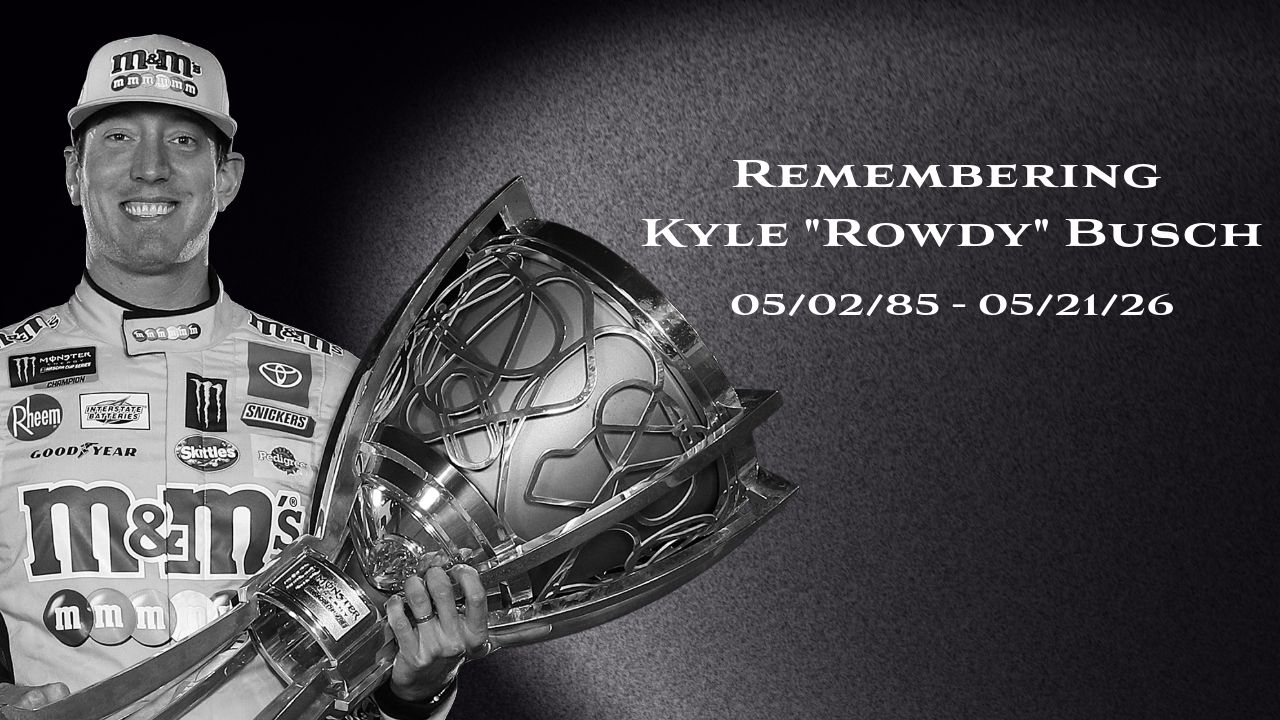
Remembering Kyle Busch: NASCAR’s Last Great Heel

Kyle Busch tragically passed away on May 21st, 2026, as initially reported by NASCAR

Few drivers in modern NASCAR history were as talented, controversial, dominant, and unforgettable as Kyle Busch. To some fans, he was the arrogant villain who always had something to say. To others, he was the fiercest pure racer of his generation, a driver willing to race anything with four wheels at any track, any night of the week. Love him or hate him, NASCAR was never boring when Kyle Busch was around.

From his early days as a teenage prodigy to becoming the face of Toyota’s rise in NASCAR, Busch built one of the most important careers the sport has ever seen. His story was one of raw talent, public controversy, redemption, and longevity. In many ways, he carried NASCAR through one of its most difficult modern eras while becoming one of the defining stars of the 2000s and 2010s.

The Start of “Rowdy”

Born in Las Vegas, Nevada, Kyle Busch was introduced to racing at an incredibly young age. Following in the footsteps of his older brother Kurt Busch, Kyle began racing go karts before moving into Legends cars and late models as a teenager. His talent became obvious almost immediately. Busch drove with aggression, confidence, and a level of car control that stood out even among NASCAR’s rising stars.

Because he was too young to legally compete in certain NASCAR events at first, Busch developed a reputation before he even reached the Cup Series. He was fearless and occasionally reckless, but undeniably fast. That aggressive style earned him the nickname “Rowdy,” a nod to the character Rowdy Burns from the movie Days of Thunder.

Rookie Sensation at Hendrick Motorsports

Busch made his NASCAR Cup Series debut in 2004, driving for Hendrick Motorsports, replacing the retiring Terry Labonte in the iconic No. 5 Chevrolet. At only 19 years old, Busch instantly showed flashes of brilliance.

In 2005, during his first full Cup season, he won twice and captured NASCAR Rookie of the Year honors. His breakout moment came at California Speedway, where he became, at the time, the youngest winner in Cup Series history. NASCAR had found its next superstar, even if fans were not sure yet whether they wanted to cheer for him or boo him.

Busch’s talent at Hendrick was unquestionable, but his personality quickly made him one of the sport’s most polarizing figures. He clashed with drivers, argued with media members, and openly showed frustration when things went wrong. At a time when NASCAR still had many corporate, polished personalities, Busch felt raw and emotional.

Even during those early years, many veterans viewed Busch as talented but immature. His aggressive driving style and emotional outbursts created tension throughout the garage, but they also made him impossible to ignore.

Becoming the Face of the No. 18

In 2008, Busch made the move that would define his career, joining Joe Gibbs Racing to drive the famous No. 18 Toyota. The switch shocked many fans. Toyota was still relatively new in NASCAR and remained unpopular among traditional audiences. Busch quickly became the perfect centerpiece for the manufacturer’s rise.

At Joe Gibbs Racing, Busch evolved from talented young driver into one of the most dominant racers NASCAR had ever seen. He won everywhere. Short tracks, intermediates, superspeedways, road courses, dirt races, trucks, Xfinity cars. If there was a steering wheel involved, Kyle Busch believed he could win in it.

His statistics became staggering. He eventually broke records for wins in the Xfinity Series and Truck Series while adding more than 60 Cup Series victories and two Cup championships in 2015 and 2019.

The 2015 title especially defined his toughness. Busch suffered devastating leg injuries during the season opener at Daytona after crashing into an exposed wall. Many thought his season was over. Instead, he returned months later, won multiple races, and captured the championship in one of the most remarkable comeback stories in NASCAR history.

Carrying NASCAR on his back

NASCAR’s popularity declined significantly from its peak in the mid 2000s into the late 2010s. Ratings fell, legendary stars retired, and the sport searched for its next generation of household names after the departures of drivers like Jeff Gordon, Tony Stewart, and Dale Earnhardt Jr..

During that period, Kyle Busch became one of the few drivers who could still consistently generate headlines, emotions, and mainstream attention. Fans either loved him or despised him, but they always reacted to him. NASCAR desperately needed personalities during an era where many drivers became increasingly media trained and cautious.

Busch embraced the role of villain in a way that felt authentic. He did not hide his anger after bad finishes. He openly criticized competitors and NASCAR itself. He celebrated aggressively when he won. That emotional honesty kept him relevant and made him one of the last true “must watch” personalities in stock car racing.

In many ways, Busch carried the old spirit of NASCAR into the modern era. He represented the rough edges and emotional intensity that many longtime fans missed.

Rivalries, Controversy, and Iconic Interviews

Kyle Busch’s career cannot be discussed without mentioning the rivalries. He feuded with nearly every major driver of his era at one point or another. His clashes with Kevin Harvick, Brad Keselowski, Joey Logano, and others became legendary moments in modern NASCAR history.

Yet underneath the controversy, there was often respect. Busch raced aggressively because he expected greatness from himself and others. Many drivers who fought with him eventually admitted they respected his talent and intensity.

That competitive fire also produced some of NASCAR’s most iconic interviews and quotes. Whether he was angrily declaring “Everything is great!” after a frustrating race or delivering sarcastic one liners during interviews, Busch became endlessly quotable. His interviews often spread across social media because fans knew anything could happen when a microphone was placed in front of him.

Unlike many athletes who tried to hide emotion, Busch wore every feeling on his sleeve. That honesty made him compelling television for nearly two decades.

Fans booed him relentlessly for years, but Busch eventually leaned into it. He understood the role he played within NASCAR. Every sport needs heroes, but every sport also needs villains. Busch became one of the last great villains NASCAR ever produced, and the sport was more entertaining because of it.

A New Chapter at Richard Childress Racing

After a long and historic run with Joe Gibbs Racing, Busch made another major career shift in 2023 by joining Richard Childress Racing. Many questioned whether Busch still had elite speed after several frustrating seasons at Gibbs.

Instead, Busch immediately revived Richard Childress Racing’s competitiveness. He won early with the team and brought energy, attention, and credibility back to one of NASCAR’s most historic organizations.

The move also reminded fans just how adaptable Busch truly was. He had now succeeded across multiple eras of NASCAR, different manufacturers, changing playoff systems, and several generations of race cars. Even late into his career, Busch remained one of the most naturally gifted drivers in the garage.

At RCR, Busch’s role within the sport began to evolve. The rebellious young driver who once angered veterans had become one of NASCAR’s established leaders and elder statesmen.

As time went on, Busch also began speaking more openly about frustrations with Richard Childress Racing’s performance and equipment. While earlier in his career fans often viewed Busch’s complaints as arrogance or immaturity, the reaction during his RCR years felt very different. Many fans believed Busch was still capable of competing for championships if he had top tier equipment beneath him.

Instead of booing him, longtime NASCAR fans increasingly rallied behind him. Even fans who once disliked Busch began hoping to see him get one final opportunity with elite equipment before the end of his career. Discussions constantly emerged about where Busch could potentially go next and whether another organization could return him to championship form.

For the first time in years, Busch was no longer viewed primarily as NASCAR’s villain. He had become something unexpected: a respected veteran racer that fans wanted to see back on top one more time.

The Hocevar Rivalry: A Full Circle Moment

That changing role became especially clear during Busch’s rivalry with young driver Carson Hocevar. Hocevar entered NASCAR carrying many of the same traits Busch once had as a rookie. He was aggressive, emotional, fearless, and willing to race veterans hard regardless of reputation.

The similarities were impossible to ignore.

Busch publicly criticized Hocevar’s driving style at times, frustrated by the young driver’s willingness to push boundaries and make enemies early in his career. Yet many fans recognized the irony immediately. Years earlier, veterans had said the exact same things about Kyle Busch himself.

The rivalry created one of the most fascinating storylines of Busch’s later career because it represented a generational mirror. Busch was now experiencing NASCAR from the opposite side of the equation. The young rebel had become the veteran defending his place against the next wave.

In many ways, the dynamic resembled the relationship between Jeff Gordon and Dale Earnhardt during the 1990s. Gordon arrived as the flashy young star changing the culture of NASCAR, while Earnhardt represented the established, intimidating veteran of the old guard. Though their rivalry contained tension, it was ultimately built on mutual respect.

The Busch and Hocevar rivalry carried that same energy. Busch may have criticized Hocevar, but there was an understanding underneath it all. Great talents often arrive in NASCAR by upsetting people first. Busch knew that better than anyone.

It became one of the most poetic full circle moments of his career.

The Legacy of Kyle Busch

Kyle Busch finished his career as one of the greatest and most influential drivers NASCAR ever produced. His accomplishments alone guaranteed his place in history, but his personality ensured he would never be forgotten.

He was NASCAR’s villain, entertainer, outspoken critic, and relentless competitor all at once. He made fans angry. He made fans cheer. Most importantly, he made fans feel something.

In an era where sports personalities increasingly became filtered and cautious, Kyle Busch remained unapologetically himself. That authenticity made him one of the defining figures of modern NASCAR and one of the last true larger than life stars the sport ever had.

Beyond the championships, victories, rivalries, and unforgettable moments, Kyle Busch will ultimately be remembered most by those closest to him. He is survived by his wife, Samantha Busch, their son, Brexton Busch, their daughter, Lennix Busch, and his brother, Kurt Busch, who shared alongside him one of the most unique family legacies in NASCAR history.

While fans will remember the wins, the interviews, the rivalries, and the intensity he brought to the racetrack every weekend, those closest to him will remember the man behind the helmet.

All of our prayers are with the Busch family, friends, team members, and loved ones during this difficult time.

-Style

WSRR Exclusive: Gatlen Gunn

A WSRR Radio Exclusive live interview with Eli Sledge & Gatlen Gunn!

Eli Sledge & Gatlen Gunn join Style on air in an exclusive interview discussing their brand new album coming up, Musical influences, Growth in music, and the community that makes up Tennessee’s local music scene! Check out the full interview below, be sure to check out Gatlen Gunn today, and listen on WSRR Radio

Interview from (05/02/26)


WSRR Exclusive: Echo Pilot (preshow)

A WSRR Radio Exclusive interview with Echo Pilot

Live in studio, Echo Pilot joins Style in an exclusive interview to discuss their upcoming show in Cleveland (04/30/26), their Spring Tour, Local Music, and more! Check out the full interview below, be sure to stream Notion, and tune in to WSRR Radio!

Interview from (04/29/26)


WSRR Exclusive: Wasted Society

A WSRR Radio Exclusive live interview with Cleveland’s own Wasted Society on their Debut Album!

Wasted Society stops by the WSRR Studio to join Style live on air in an exclusive interview discussing their brand new album, Musical influences, Growth in music, and the community that makes up Cleveland’s local music scene! Check out the full interview below, be sure to check out Wasted Society today, and listen on WSRR Radio

Interview from (04/03/26)


Style is leaving WSRR Radio

WSRR Radio Announces Leadership Change

WSRR Radio is announcing that Style will be stepping down from his roles as Owner and Program Director, effective immediately. This change comes as a result of contractual obligations that prevent his continued involvement with WSRR moving forward. Due to the nature of those agreements, no additional details will be provided.

Style founded WSRR Radio in 2024 and has been instrumental in building the station into a platform focused on independent and local artists across the country.

“I cannot begin to put into words how much WSRR means to me. Watching this entire radio station grow from a website to host a podcast to THE premiere radio station for true local and independent music has been such a blessing and such a wild ride. Thank you to all the incredible artists, sponsors, creators and people who made this possible. While it kills me to have to step away, I know WSRR Radio will continue to grow and reach new heights under Evan. Thank you all.”

-Style

Effective immediately, Evan “The Pige” Sinarski will take over as Program Director. A familiar voice on WSRR and host of The Pigeon Hole, Pige has been closely involved with the station and will now oversee all programming.

“I want to thank Style for everything he’s built here. WSRR doesn’t exist without him, and I think anyone who’s been listening for even five minutes knows how much of this station has his fingerprints on it. Stepping into this role isn’t something I take lightly, and I’ve got a lot of respect for what he’s put together. That said, I’m excited for what comes next. We’re going to keep doing what WSRR does best, supporting independent artists, staying unpredictable, and continuing to build something that actually feels different from everything else out there. In the spirit of moving forward, Style will be taking the “S” with him. Effective immediately, we will be rebranding as WRR Radio.

-Evan “The Pige” Sinarski

WRR will continue operating as normal, with no changes to its current lineup. Finally, The above announcement was an April Fools Day joke. Style remains Owner and Program Director of WSRR Radio, and there are no changes to station leadership or operations. Evan “The Pige” Sinarski will also not be removing any letters from the station name.

WSRR Exclusive: I’d Like To Go Home Now

A WSRR Radio Exclusive live interview with Akron’s own I’d Like To Go Home Now on their New Album: Time To Go

I’d Like to Go Home Now stops by the WSRR Studio to join Shayne E. live in an exclusive interview discussing their brand new album Time To Go, Music Background, Band Synergy , and the community that makes up Ohio’s local music scene! Check out the full interview below. Be sure to check out I’d Like to go Home Now’s latest album, Time To Go, and tune in to WSRR Radio!

Interview from (03/22/26)


A Conceptual Model of How Dreams Interconnect

Style

Bon Jovi Invented “John Fallout”

Is the classic rock legend JBJ really responsible for the iconic “John” meme?

We all know the “John” meme by now. Simply take the name of something and add “John” in front of it, and there you go, your new de facto main character. John Fallout, John Halo. Hell, when I worked at GameStop we even had a running gag about the company’s “founders,” Johnathan Game and Robert Stop. Why is it funny? I have no idea. Maybe it’s deep fried internet humor. Maybe it’s pure brain rot. But whatever the reason, it seems like the joke is here to stay.

Earlier this week I was driving in my car when Alice Cooper came on the radio. That reminded me of a conversation I had years ago with a listener: is Alice Cooper the man, or the band? The answer is technically both. Originally, it was The Alice Cooper Band, fronted by Vincent Damon Furnier. As the group grew in popularity, Furnier began performing under the name Alice Cooper himself, eventually adopting it as his legal name. What started as a band name became a person.

Once you notice that phenomenon, you start seeing it everywhere. Take Van Halen. The band is named after Eddie and Alex Van Halen, but when someone says “Van Halen,” you almost always think of the band itself rather than the brothers individually.

Then there’s Bon Jovi. Most people assume Bon Jovi is simply Jon Bon Jovi’s name. But technically, it isn’t. Jon’s real last name is Bongiovi. “Bon Jovi” started as a stylized version of that name — a band name, not a personal one. But as the group became famous, Jon adopted Jon Bon Jovi as his stage name, essentially taking the band’s name as his own surname.

And that’s when it hit me. Jon Bon Jovi might have accidentally invented the “John” meme decades before the internet did. Think about it. The band name becomes the character’s name. If the situation was identical but Jon happened to front Nirvana instead, it would be the equivalent of John Nirvana.

The internet may think it invented the “John” meme, but the truth is that rock and roll might have gotten there first. And somewhere out there, John Fallout is probably very proud.

-Style

WSRR Exclusive: Eli Moon II

A WSRR Radio Exclusive live interview with Cleveland’s own Eli Moon on his New Album: Golden Child

Eli Moon stops by the WSRR Studio to join Style live on air in an exclusive interview discussing his brand new album Golden Child, mental health, Growth in music, and the community that makes up Cleveland’s local music scene! Check out the full interview below, be sure to check out Moon’s latest album, Golden Child, and tune in to WSRR Radio!

Interview from (02/27/26)


Eli Moon’s Previous Interview Below!

Hank Williams I-IV

A Family Tradition

Hank Williams Sr.

Before there was a “Hank Williams”, there was Hiram King Williams.

“Hank” was never even his first name. It was his middle name, a nickname that hardened into identity and eventually eclipsed the name printed on his birth certificate in 1923. Over time, he made “Hank” mean something singular. Not just a person. A force.

There have been countless men named Hank in American history. But when someone says “Hank” without a last name, they do not mean just anyone. They mean him.

Very few figures in American culture accomplish that. In another corner of American mythology, the comparison might be “Dale.” There are thousands of Dales. But say it in the right room, especially in the South, and people hear one man: Dale Earnhardt.

Hiram King Williams did that with “Hank.”

And then he left it behind.

Born into poverty in rural Alabama, raised largely by his mother while his father struggled with illness and absence, Hank absorbed church hymns and the blues stylings of Rufus “Tee Tot” Payne. That fusion of gospel conviction and Delta ache became the spine of his songwriting. He had melody, but more importantly, he had emotional precision.

Many argue he is not just one of the greatest country songwriters of all time, but one of the greatest American songwriters, period. The simplicity was deceptive. “I’m So Lonesome I Could Cry” reads almost childlike until you sit with it long enough to feel the isolation vibrating beneath every line. “Your Cheatin’ Heart” does not rage. It does not accuse.

It resigns.

And the more you listen, the more you learn the circumstances around it, the more you dissect the phrasing and the restraint in his delivery, the deeper it becomes. On the surface, it is a song about betrayal, about an unfaithful partner whose conscience will eventually catch up with them. But when you understand Hiram King Williams as a man battling addiction, chronic pain, guilt, faith, and self destruction, the song opens wider.

It stops sounding like an accusation.

It starts sounding like a confession.

“Your cheatin’ heart will make you weep” feels less like a warning to someone else and more like a quiet reckoning with himself. Hank was not only singing about someone who had betrayed him. He was singing about the parts of himself he could not outrun. That duality is what separates great songwriting from immortal songwriting. The words operate on two levels at once, the personal and the universal, the outward and the inward.

That depth is why the catalog has endured.

He was not just documenting heartbreak.

He was documenting consequence.

And even in his own lifetime, there were two Hanks. The honky tonk star cutting jukebox hits and Luke the Drifter, the alias under which he recorded spoken word moral recitations and spiritual reflections. The label kept those records separate so patrons would not mistake sermons for barroom laments. But the separation never truly existed. The struggle between sin and salvation ran through all of it.

Yet before the collapse, there was ascent. By the late 1940s and early 1950s, Hank Williams was not merely successful. He was redefining country music’s commercial identity. He scored a string of number one hits including “Move It On Over,” “Lovesick Blues,” “Long Gone Lonesome Blues,” and “Cold, Cold Heart.” His performances on the Grand Ole Opry electrified audiences. In an era before television dominance, Hank’s voice poured through radios across the South and beyond. He did not just belong to country music’s golden era. He helped build it.

And in 1949, at the height of that rise, he became a father.

His son was named Randall Hank Williams. Randall for individuality. Hank for inheritance. Within the family, Hank affectionately called the boy “Bocephus,” a nickname borrowed from Grand Ole Opry comedian Rod Brasfield, who had jokingly compared young Randall to a popular ventriloquist dummy character of the same name. What began as humor became intimacy. What began as a joke became identity. For Hiram, “Bocephus” was tenderness. For Randall, it would become an expectation.

By the early 1950s, the weight of everything, fame, pain, alcohol, and pressure, was visible. Chronic back issues from spina bifida occulta, erratic performances, and dismissal from the Grand Ole Opry. The unraveling was no longer private. On January 1, 1953, at just 29 years old, Hiram King Williams died in the backseat of a Cadillac on the way to a show.

He did not live long enough to see what “Hank” would become.

He did not live long enough to raise his son.

Hank Williams Jr.

Randall Hank Williams was eight years old when his father died.

He did not inherit memories. He inherited mythology. Audrey Williams understood that the name “Hank” had become more than personal. It was cultural currency. And so Randall was introduced to audiences not simply as a child performer, but as living continuity. He was dressed like his father. Taught to sing his father’s songs. Positioned as proof that the legend had not died in the backseat of that Cadillac. Before he was a teenager, he was performing “Lovesick Blues” and “Your Cheatin’ Heart” for crowds who wanted to believe the ghost still sang.

The nickname “Bocephus,” once a father’s affectionate joke, followed him onto stages and album covers. Over time, Randall leaned into it, reshaped it, and weaponized it. Bocephus became bigger, louder, harder. It became the identity that allowed him to survive the comparison. But surviving the comparison was never simple. He was not just compared to a father. He was compared to a father who died in the backseat of a Cadillac and became immortal because of it.

That weight of tragedy, mythology, and expectation followed him for decades. It is perfectly showcased in his later songs “Living Proof” and “Standing in the Shadow.” In “Standing in the Shadow,” he confronts directly what it means to grow up in the silhouette of a legend. In “Living Proof,” he asserts that he is not merely the son of greatness, but evidence that the bloodline carries its own strength. Those songs are not tributes. They are negotiations with inheritance.

For years, critics saw imitation. Industry executives saw nostalgia revenue. What Randall felt was suffocation. He was not allowed to discover who he was without first proving he could be who his father had been. The breaking point came in 1975 when a near fatal mountain climbing accident crushed his face and required extensive reconstructive surgery. When he returned, something had shifted. The echoes of Hiram were replaced with southern rock muscle and outlaw defiance.

“Family Tradition” was not just a hit. It was a declaration that the Williams name would not be frozen in black and white photographs. Randall Hank Williams stopped trying to resurrect Hiram. He decided instead to stand beside him. And once he did, the career that followed was not imitation. It was dominance.

Through the late 1970s and into the 1980s, Hank Jr. became one of the defining figures of outlaw country and southern rock. Albums like Whiskey Bent and Hell Bound, Habits Old and New, and Born to Boogie cemented his reputation as something distinct from his father. He built an audience that was not listening out of nostalgia, but loyalty. He was no longer Hank’s boy. He was Bocephus.

The industry that once tried to package him as a replica now had to acknowledge him as a force in his own right. He won multiple Entertainer of the Year awards from both the CMA and ACM. He became a stadium act. His voice opened Monday Night Football broadcasts for a generation. By the time he was inducted into the Country Music Hall of Fame in 2020, it was less about legacy and more about inevitability. He had not merely survived the name. He had expanded it.

But legacy in the Williams family does not move in straight lines. It multiplies.

Randall Hank Williams became a father himself. Among his children were Shelton Hank Williams, later known as Hank III, born in 1972, and Sam Williams, born decades later into a world where the myth had already solidified into history. The name “Hank” was passed down again, not by accident, but by intention. Hiram had named his son Randall Hank, embedding inheritance in his middle name. Randall would name his son Shelton Hank, embedding it again. Each generation kept the name alive, even as they wrestled with what it meant.

For Hank Jr., fatherhood added another dimension to the weight he carried. He knew firsthand what it meant to grow up under a legend you could never measure up to. Yet he passed the name forward anyway. Not to create another replica, but perhaps to reclaim it on his own terms. If Hiram created the myth, and Randall survived it, the next generation would have to decide whether to embrace it or fracture it.

And Shelton Hank Williams would choose to fracture.

Hank III

Shelton Hank Williams was born in 1972 into a family where the mythology was no longer fragile. It was cemented. By the time he was old enough to understand his name, “Hank Williams” was not just history. It was an institution. It was Hall of Fame plaques and greatest of all time lists. It was radio specials and legacy tours. For Shelton, the inheritance was not a ghost. It was infrastructure.

His relationship with his father has at times been publicly strained, particularly over artistic direction and the pressures of image. Where Randall had fought to step out of imitation, Shelton seemed determined to reject the entire machinery that surrounded the Williams brand. There were disagreements about record contracts, about presentation, about how the name “Hank” should be used. Shelton has spoken openly about feeling pushed into commercial lanes he did not believe in.

There is irony in that tension. Randall grew up suffocated by expectations tied to his father. Shelton grew up resisting expectations tied to his own. The struggle had simply moved one generation forward.

Shelton embraced traditional honky tonk with purist intensity, releasing records that felt closer in spirit to Hiram’s raw emotional core than to polished Nashville production. But at the same time, he fronted the metal band Assjack, performing abrasive, confrontational music that seemed intentionally designed to shatter expectations. It was not confusion. It was a declaration. He would not be boxed in.

If Hiram embodied tension between sin and salvation, and Randall embodied tension between imitation and independence, Shelton embodied tension between preservation and rebellion. He often spoke reverently of his grandfather, describing the honesty and unfiltered pain that defined Hiram’s writing. In many ways, Shelton saw himself not as destroying the lineage, but stripping it back to its nerve.

And yet, despite the distance between father and son, there was one moment where the bloodline converged in a way that felt almost surreal. In 1996, the album Three Hanks: Men With Broken Hearts was released. Using archival recordings of Hank Sr., alongside new performances from Hank Jr. and Hank III, the project blended three generations into a single record. Technology layered their voices together, particularly on the title track “Men With Broken Hearts,” a spoken word reflection originally recorded by Hiram under his Luke the Drifter alias. Grandfather. Father. Son. One song.

It was part tribute, part studio experiment, part historical event. Some critics debated the ethics of posthumously merging recordings. Others saw it as a powerful artistic gesture. But beyond the production debate, the symbolism was undeniable.

Hiram King Williams had once delivered “Men With Broken Hearts” as a meditation on empathy, suffering, and quiet dignity. Decades later, his son and grandson were woven into that same narrative. Whether they aligned creatively or clashed privately, they were bound together in that refrain.

There is something almost too fitting about that being the connective thread. Because if any phrase captures the Williams lineage, it may be exactly that. Men with broken hearts.

Hiram battled pain and addiction. Randall battled comparison and expectation. Shelton battled control and commodification.

The album did not erase the tension between Shelton and his father, It did not resolve artistic disagreements, But it made something clear, No matter how much they fractured stylistically or personally, they were singing from the same inheritance. The name did not disappear when challenged. It adapted. Each generation reacts differently to the weight. Hiram created the myth. Randall fought to survive it. Shelton tested its limits. And the story was still unfolding.

Sam Williams

By the time Sam Williams stepped into the public eye, the battles that defined earlier generations had already been fought. Born in 1997, Sam is the son of Hank Williams Jr. and the younger half-brother of Shelton Hank Williams, known professionally as Hank III. That alone places him in a uniquely layered position within the family tree. He is not only the grandson of Hiram King Williams and the son of Randall Hank Williams, but also the brother of the generation that openly fractured from the industry structure surrounding their name.

Unlike Randall, who grew up in the immediate aftermath of his father’s death, or Shelton, who came of age pushing aggressively against the machinery attached to the Williams brand, Sam entered a world where the mythology was no longer raw. It was documented, archived, and cemented into the canon of American music. “Hank Williams” was not an unfolding legend by the time Sam was old enough to understand it. It was settled history.

That distinction shaped his approach.

Sam’s music does not carry the same outward defiance that defined his father, nor the confrontational intensity that marked Hank III’s work. Instead, it leans inward. His songwriting is reflective and emotionally transparent, drawing more from vulnerability than from rebellion. He has spoken openly about grief, particularly the loss of his sister Katie Williams in 2020, and about navigating identity within a family whose name carries immense cultural gravity. Those themes appear in his work not as attempts to dismantle legacy, but as attempts to humanize it.

The dynamic is notable when viewed alongside his brother’s path. Hank III positioned himself as a challenger to the commercial structures that surrounded the Williams name, often resisting industry expectations and distancing himself from mainstream country. Sam, by contrast, does not seem interested in fighting the myth or escaping it. He acknowledges it, lives with it, and writes through it. The tension that once defined the relationship between father and son in previous generations feels less explosive here. The inheritance is still present, but it is handled with awareness rather than confrontation.

In many ways, Sam represents a tonal evolution within the lineage. Hiram wrote from internal conflict and spiritual struggle. Randall fought to separate himself from imitation. Shelton tested the limits of the brand itself. Sam appears to accept that the myth exists and then moves forward anyway, allowing it to inform his work without letting it dictate its shape.

The evolution of the Williams bloodline is not linear, but it is unmistakable. What began as a middle name became a monument. That monument became a burden for one generation and a battleground for another. Now it feels closer to a foundation. The question that has echoed through each generation remains: how do you create something authentic when the world is already listening for echoes of your last name?

Sam’s answer is quieter than those before him, but no less meaningful. He writes in his own voice, fully aware that it carries history. And perhaps that is the most striking transformation in the Williams lineage. The inheritance is no longer something to outrun or fracture. It is something to navigate.

And in that navigation, the bloodline continues.

IV (and his strange band)

Coleman Emmett Williams, who performs simply as IV, represents the fourth generation of the direct Williams bloodline. He is the son of Shelton Hank Williams, known as Hank III, which makes him the grandson of Randall Hank Williams and the great grandson of Hiram King Williams. Unlike earlier generational titles that were publicly attached at birth, Coleman was not widely introduced to the world as “Hank Williams IV” in the same immediate way his father and grandfather were. Instead, he chose to adopt the moniker “IV” professionally, a subtle but deliberate acknowledgment of his place in the lineage.

That distinction is important.

The earlier generational markers were almost unavoidable. Hank Jr. was defined by being the son of Hank Sr. Hank III carried both the name and the numeric continuation openly. Coleman, however, chose a slightly different path. By going simply as IV, he signals awareness of the bloodline without allowing the full weight of “Hank Williams” to precede every introduction. It is both an inheritance and a boundary.

His upbringing reflects that generational complexity. Raised primarily by his mother in his early years and later spending time around his father’s orbit, Coleman grew up immersed not only in country music but also in punk and alternative scenes that surrounded Hank III. The sonic landscape he inherited was broader than the honky tonk foundation of his great grandfather or the southern rock dominance of his grandfather. By the time he emerged as an artist, the Williams name had already traveled through multiple stylistic evolutions.

What makes IV’s place in the story compelling is that he exists after the myth has already been debated, fractured, defended, and expanded. He did not grow up trying to live up to a legend who had just died. He did not grow up trying to break free from direct comparison in the same immediate way Randall did. Nor did he need to rebel against mainstream country in the aggressive fashion of his father. Instead, he steps into a lineage that has already proven it can survive tension.

And yet the inheritance remains visible.

As the son of Hank III, IV carries forward not just the name but the rebellious streak that has marked the Williams line since Randall’s transformation into Bocephus. At the same time, being the great grandson of Hiram King Williams places him only three generations removed from the origin of it all. In the broader arc of American music history, that is remarkably close.

What began as Hiram’s middle name has now moved through four generations.

That continuity is rare.

The Williams bloodline is no longer just a story about a tragic genius who died young. It is a story about what happens after myth becomes family history. Each generation has confronted the same inheritance under different circumstances. Hiram created the standard. Randall fought to survive it. Shelton challenged its structure. Sam reflects on it. Coleman acknowledges it while carving space within it.

The name did not fade.

It adapted.

And with IV, the lineage is no longer theoretical. It is living proof that the weight of Hiram King Williams did not end in a Cadillac in 1953. It continues to evolve, not as imitation, but as response.

Nearly a century after Hiram King Williams turned his middle name into a monument, the bloodline he began is still unfolding. Hank Jr. fought to stand beside a legend rather than beneath it. Shelton tested the boundaries of what that legend could withstand. Sam approaches it with reflection instead of resistance. IV acknowledges it while shaping his own path within it. The story of the Williams family is not simply about talent passed down through generations. It is about how a name became larger than a man, and how each generation has found a way to carry that weight without letting it define them entirely.

Style